
Traveling in Hanoi offers numerous beautiful and enticing destinations for tourists. Among them, Ngoc Son Temple is always a top choice for visitors. In the following article, DanangPrivateCar.com’s shares with everyone the travel experience to Ngoc Son Temple that tourists should not miss.
Introduction to Ngoc Son Temple
Location: Ngoc Island, Hoan Kiem Lake, Dinh Tien Hoang Street, Hang Trong Ward, Hoan Kiem District, Hanoi
Ticket prices for reference:
- Adults: 30,000 VND/person
- Children under 15 years old: Free admission
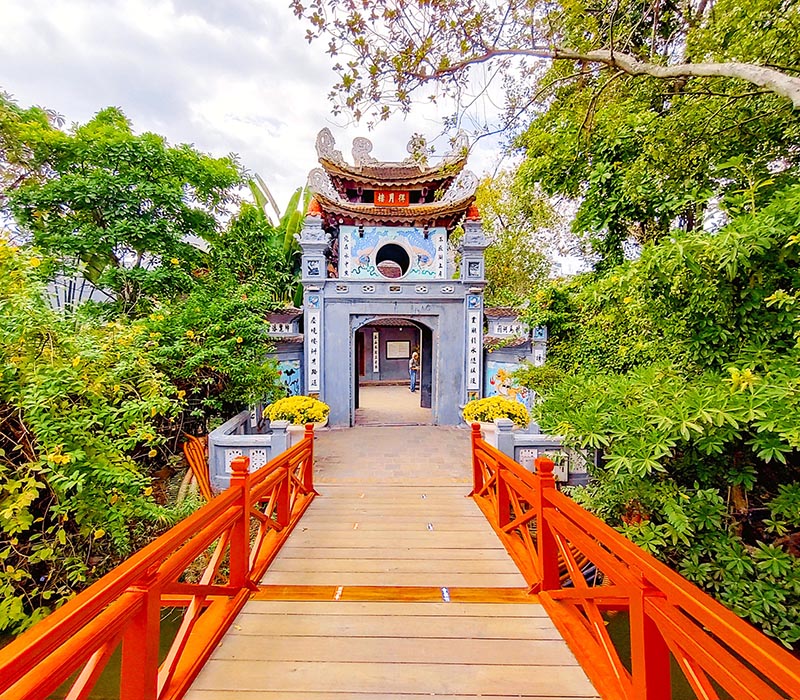
Ngoc Son Temple is located on Ngoc Island, in the northeast of Hoan Kiem Lake. This structure, combined with the Turtle Tower, forms the most famous cultural and historical complex in Hanoi, featured in many literary works and artworks. Despite being situated in the bustling capital, attracting many visitors, Ngoc Son Temple maintains its tranquility, solemnity, and profoundly sacred atmosphere.
When to visit Ngoc Son Temple?
Ngoc Son Temple is a spiritual tourism destination, so tourists can visit and make offerings at the temple. For tourism to Ngoc Son Temple in Hanoi, tourists should visit at the beginning of the year to pray for luck, health, and success. Tourists can visit Ngoc Son Temple at any time of the year to explore and admire the scenery at the temple.
The Construction History of Ngoc Son Temple
Ngoc Son Temple was built to worship Hung Dao Dai Vuong Tran Quoc Tuan and Van Xuong De Quan, the patron saint of literature and scholarship. It also houses Buddhist altars and Confucian shrines, symbolizing the Vietnamese belief in the unity of the Three Religions (Buddhism, Taoism, and Confucianism). The temple’s architecture, couplets, and decorative motifs all reflect this harmonious fusion.
Originally constructed in the early 19th century to worship Quan De, a deity believed to ward off evil and bring blessings, the temple was first named Ngoc Tuong when King Ly Thai To moved the capital to Thang Long. During the Tran dynasty, it was renamed Ngoc Son and became a place to honor fallen heroes who fought against the Yuan-Mongol invaders. Later, the temple collapsed due to an unstable foundation.
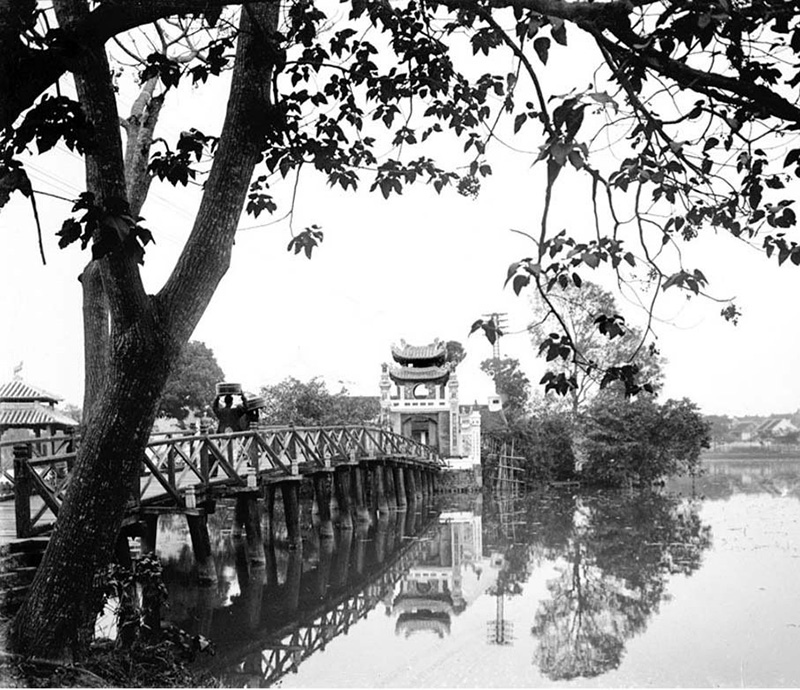
During King Vinh Huu’s reign under the Le dynasty, Lord Trinh Giang ordered the building of Khanh Thuy Palace on the eastern shore of Hoan Kiem Lake, near the temple’s original site. After its partial destruction at the end of the Le dynasty, villagers of Ta Khanh rebuilt it as Khanh Thuy Temple.
Subsequently, a philanthropist named Tin Trai rebuilt Ngoc Son Pagoda at the old palace site. It was later taken over by another association, renamed Tam Thanh Temple, and transformed into Ngoc Son Temple after installing a statue of Van Xuong De Quan.
In 1865, scholar Nguyen Van Sieu renovated the temple, expanded its grounds, built stone embankments, the Pen Tower, Ink Slab, Trấn Ba Pavilion, and the iconic The Huc Bridge connecting the temple to the lake’s eastern shore.
Guide to Getting to Ngoc Son Temple
Because Ngoc Son Temple is located in the city center, getting there is quite easy, and you can travel by either self-driving or public transportation.
If you’re traveling by private vehicle, you can choose one of the following routes:
- Route 1: Kham Thien → Tran Hung Dao → Hang Bai → Dinh Tien Hoang
- Route 2: Giang Vo → Nguyen Thai Hoc → Hai Ba Trung → Dinh Tien Hoang
- Route 3: Dai Co Viet → Hue Street → Dinh Tien Hoang
If you prefer the convenience of traveling by bus, you can choose from the routes suggested by DanangPrivateCar.com:
- Route 08: Departing from Long Bien bus station
- Route 14: Departing from Co Nhue
- Route 31: Departing from Bach Khoa University
- Route 36: Departing from Long Bien transfer point
Furthermore, if you’re looking for door-to-door transportation and want to explore multiple tourist destinations, choosing a tour car rental service with a driver in Hanoi from DanangPrivateCar.com’s will help you save costs and time during your trip. With a team of professional drivers and many years of experience, you’ll have the safest and most comfortable journey. Additionally, with transparent pricing and no hidden fees, you can avoid overcharging situations when choosing public services in Vietnam. Book with us today to arrange your itinerary in advance.
Explore the Beauty of Ngoc Son Temple
The Huc Bridge
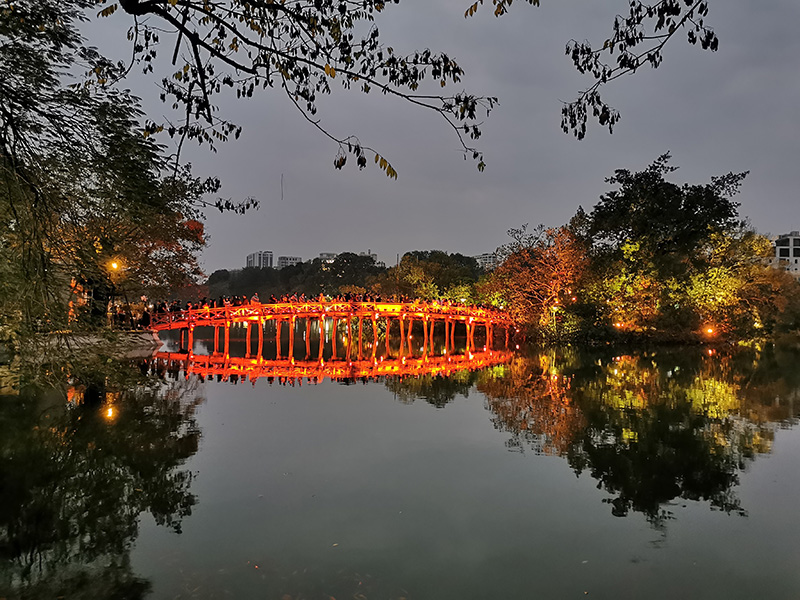
The Huc Bridge, painted in vermilion, curved like a shrimp, leads to Ngoc Son Temple, as familiar as the sentences we learn in textbooks. This bridge is built of wood, prominently painted in red. It is the only way for you to enter Ngoc Son Temple and is also a very famous check-in spot in Hanoi. Especially at night when lit up, the beauty of The Huc Bridge becomes even more mystical.
Visit the Pen Tower – Ink Slab
Right in front of Ngoc Son Temple’s entrance, you will see the image of a five-story tower built of stone blocks, and that is the Pen Tower. This structure was built in 1865, located on Ngoc Boi Mountain. On the top of the Pen Tower are inscribed three characters “Ta Thanh Thien,” meaning “Writing on the blue sky,” expressing the significance of knowledge being able to master nature and the heavens.
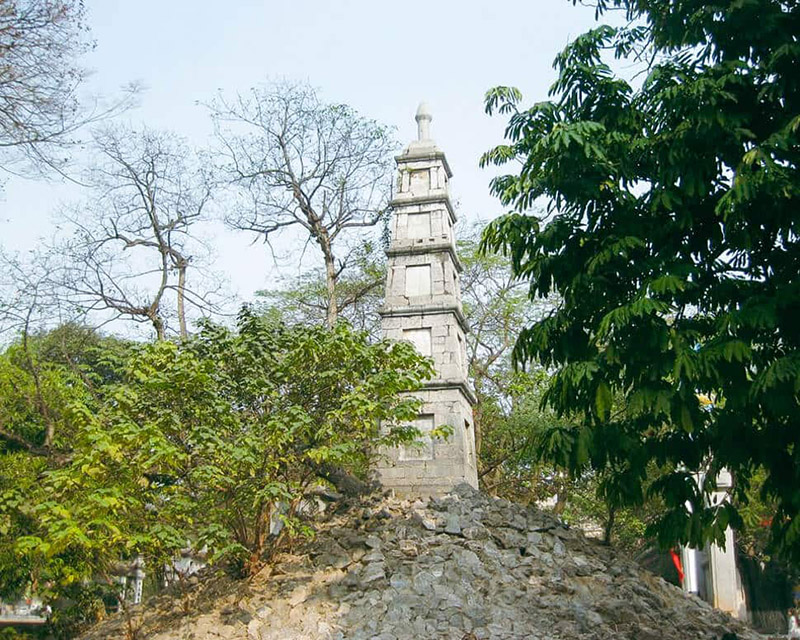
At the foot of the Pen Tower is an inkwell-shaped ink slab cut in half vertically, this is the Ink Slab. Below the Ink Slab are three turtle-shaped pedestals, with a poem carved on the body by Confucian scholar Nguyen Van Sieu. At noon, when the sun is directly overhead, the Pen Tower will cast a shadow onto the Ink Slab, creating a very impressive image.
Discover the Architecture of Ngoc Son Temple
Despite several renovations, Ngoc Son Temple has preserved its traditional architectural beauty. From the outer gate, visitors can admire walls decorated with dragon and tiger motifs, accompanied by Chinese couplets symbolizing the Vietnamese people’s love of learning.
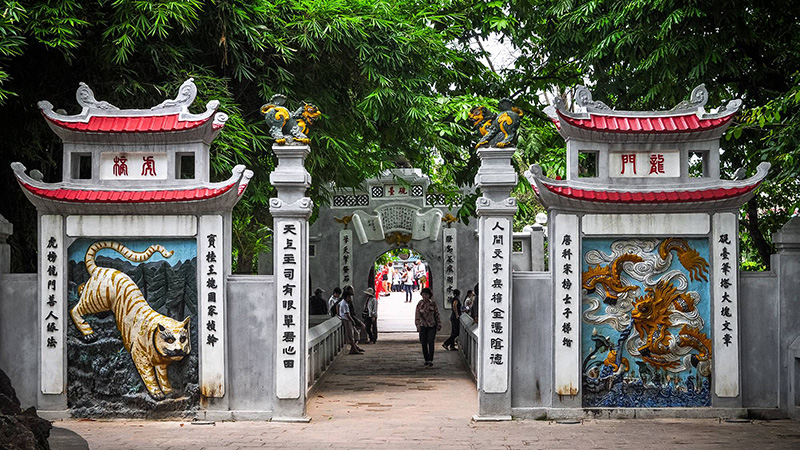
Crossing The Huc Bridge, you will first encounter the Moon Contemplation Pavilion, featuring two arched roofs with cloud-shaped reliefs at the corners. The pavilion also displays two embossed murals: Long Ma Ha Do on the right and Than Qui Lac Thu on the left.
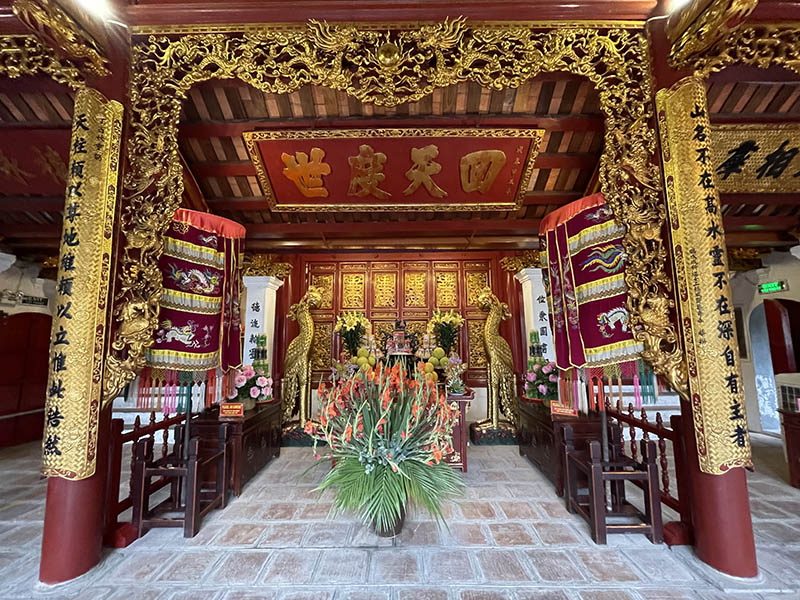
The temple’s layout follows the Chinese character “Tam” (Three), comprising three sections: the front courtyard, middle courtyard, and rear palace. The front courtyard is a worship area with a large incense burner and two brass cranes. The middle courtyard honors deities symbolizing knowledge—Van Xuong, Quan Vu, and La To. The rear palace venerates national hero Tran Hung Dao, who led Vietnam to victory over the Mongol invaders three times.
To the south lies Tran Ba Pavilion (Wave-Blocking Pavilion), a square structure with eight roofs supported by eight columns—four made of stone and four of wood.
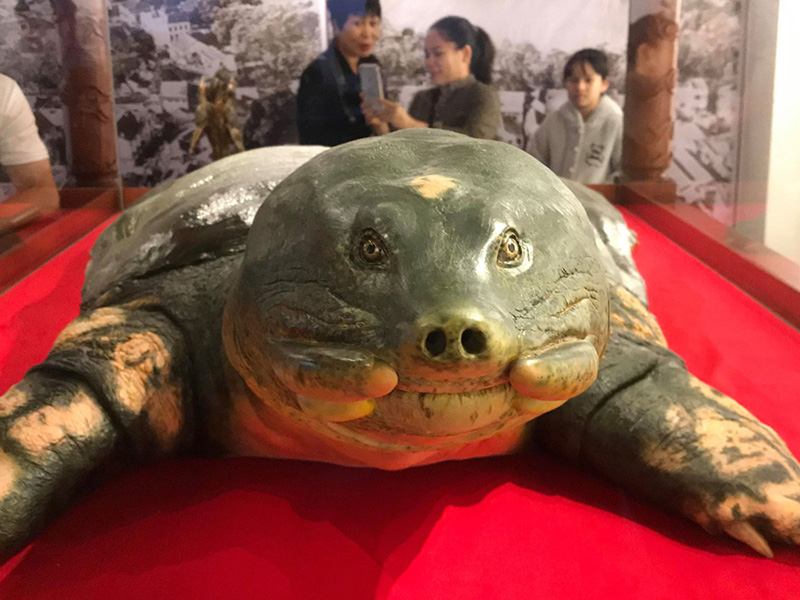
Inside the temple are two replicas of sacred turtles displayed in glass cases: one representing the turtle found in 1967 and the other from 2016. These relics evoke the legendary tales of the Hoan Kiem Lake turtles, which have long fascinated visitors who come to witness this symbol of Hanoi’s spiritual and historical heritage.
Notes when visiting Ngoc Son Temple
- You can visit Ngoc Son Temple any day of the year. However, it can be quite crowded on the first and fifteenth days of the lunar month, so it’s better to choose a regular day when it’s less crowded.
- When entering the main temple, please note to enter through the side doors and avoid the central door.
- During the temple visit, tourists should ensure to maintain order, dress modestly, and maintain a solemn attitude.
- Limit taking photos inside the worship area.
Ngoc Son Temple is a tourist destination that surely no one can overlook when visiting the capital city of Hanoi. Hopefully, with the shared experiences about visiting Ngoc Son Temple here, it will help travelers have a wonderful trip and gain more valuable knowledge about Vietnamese temples.

